
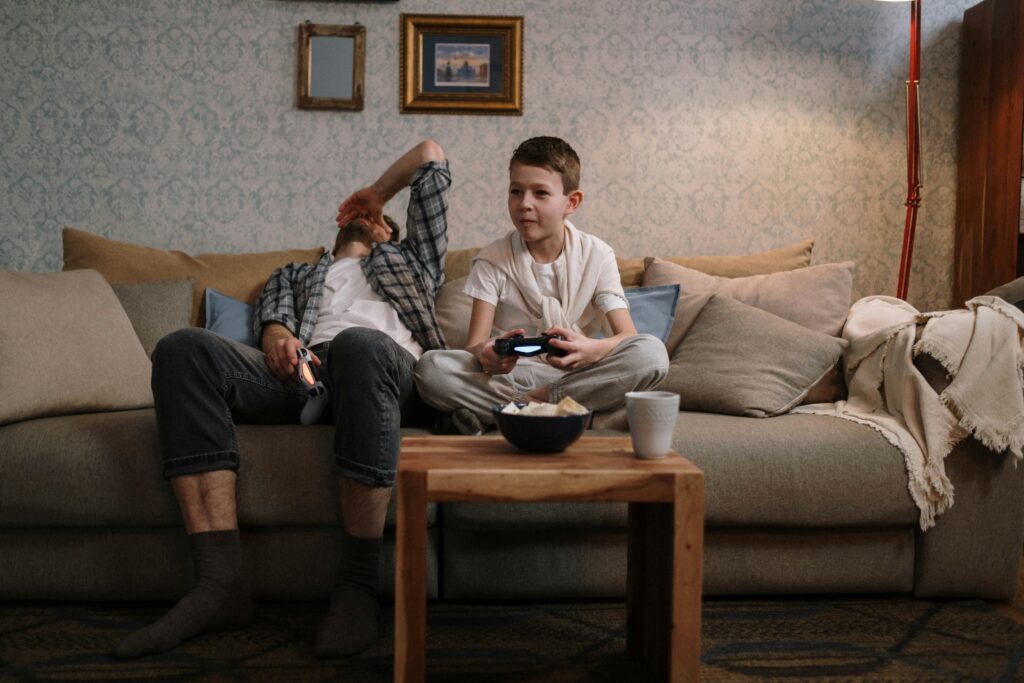
You gave a warning. You were calm. You even let them have an extra ten minutes like some kind of patient, saintly, unreasonably reasonable human being.
And they still lost their mind.
Cool. Great. Totally fine.
Here is the thing though: you did nothing wrong. What you are running into has nothing to do with how you asked, how nice you were, or how many warnings you gave. It is a brain thing. Specifically, it is a very specific set of neurological realities that make this exact situation almost inevitable without the right approach.
Let me break down what is actually happening, because once you see it, everything changes. And I mean that in a practical way, not a fortune cookie way. By the end of this you will have specific things you can try today and see a real difference.
First, Let’s Talk About What Video Games Are Actually Doing to That Brain
The ADHD brain is chronically low on dopamine. Not “a little sluggish” low. Measurably, structurally, neurologically low. Brain imaging research, including SPECT scan studies that look at actual blood flow in the brain, consistently shows reduced activity in the prefrontal cortex — the region responsible for impulse control, time perception, planning, and decision-making — in people with ADHD.
Here is the thing about an underactivated prefrontal cortex: the brain notices. And it goes looking for something to fix it.
Video games are one of the most effective dopamine delivery systems ever engineered. Every level completed, every enemy defeated, every reward unlocked, every notification — the game is built to produce a constant, reliable stream of the exact chemical your child’s brain is starving for. Research published in NIH-indexed journals found that children with ADHD show addiction scores related to gaming nearly double those of neurotypical kids. The more severe the ADHD, the stronger the pull.
Your kid is not being defiant. Their brain found the one place it feels regulated, competent, and calm. And you just asked them to leave.
That reframe is important. The behavior is not manipulation. It is the brain communicating something real. When you understand it that way, your whole approach shifts from frustration to strategy.
Why Time Warnings Are Basically Useless (Sorry)
This is the part that genuinely blew my mind when I first understood it.
Some of the most rigorous ADHD research available describes what happens to time perception in an ADHD brain, and it is wild. The ADHD brain lives in a permanent state of “now versus not now.” There is right now. And then there is a vague, unreal space where everything else lives. The future is not a real, tangible thing the ADHD brain can feel. It is a concept.
So when you say “ten more minutes,” your child genuinely hears you. And then their brain files it somewhere in that vague not-now space. The countdown does not register. Time does not feel like it is passing. And when you come back, it lands exactly as sudden as if you had given zero warning at all.
This is called time blindness, and it is not attitude. It is documented neurology. Research published in peer-reviewed journals on executive function deficit in ADHD consistently identifies time perception as one of the core impairments. Studies have found that children with ADHD are developmentally about 30 percent behind their neurotypical peers in self-regulation. A twelve-year-old with ADHD may be operating more like an eight or nine year old when it comes to managing time, transitions, and impulse control.
You are not failing to communicate. Your child is failing to process time the way you expect them to. Those are different problems with different solutions.
On top of the time blindness, you are pulling them out of a high-dopamine state and back into regular life, which for most ADHD kids is a low-dopamine, low-stimulation environment. Their nervous system is not just annoyed. It is experiencing something closer to withdrawal.
There Is Also an Autonomy and Emotional Regulation Layer Here
ADHD brains are especially sensitive to external control. When your child is deep in a gaming session and you show up with a directive, their nervous system can register it as a threat before they have even processed your words. The interruption itself triggers a stress response.
If your child also has ODD tendencies — which research shows co-occurs with ADHD in a significant percentage of cases — this response is amplified. The compliance system is already stretched thin, and the alarm goes off fast.
Research on emotional dysregulation in ADHD shows that these kids can experience emotional reactions up to three times more intensely than their peers, and they take significantly longer to return to baseline once activated. So the meltdown is not disproportionate to their inner experience. It actually makes perfect neurological sense.
That does not mean you let it run the house. It means you stop trying to fix it with logic in the middle of it, because there is zero logic available when the prefrontal cortex goes offline during emotional flooding. You work around it instead.
What Actually Works — Things You Can Try Today
Before the gaming session: set the checkpoint, not the clock
Before they pick up the controller, establish the stopping point together. Not “you can play for an hour.” Instead: “when you finish this match” or “when you get to the next save point.” Let them help choose the checkpoint when possible.
This does two things. It gives their brain a real, tangible endpoint — something they can see coming rather than an invisible clock they cannot feel. And it gives them a sense of ownership over the decision, which removes the autonomy threat before it can even develop.
During the session: show up curious, not commanding
When the time is approaching, do not walk in with a directive. Walk in curious. Ask what game they are playing. Ask what they are working on in it. Let them tell you for thirty seconds. This shifts your role from the person who takes things away to the person who is actually interested in their world.
Then say: “Okay. When you beat that boss, it is time to hop off.”
Here is why this specific wording works at a neurological level. Defeating a boss or completing a level already produces a dopamine release inside the game. When you link the stopping point to that moment, you are tagging the hippocampus — the brain’s memory and reward center — to associate getting off the game with a feeling of accomplishment rather than loss. The transition becomes part of the win instead of the end of it.
You also give their brain a visible, processable countdown. They can see the boss health bar dropping. They know the level is almost over. That is a real endpoint their brain can actually feel approaching, nothing like “ten minutes” which is neurologically meaningless.
If a meltdown happens anyway
It will sometimes. Especially at first, or on high-stress days.
Do not escalate. An escalating adult meeting a dysregulated ADHD brain is like dumping gasoline on a fire and then being surprised the fire got bigger. When the prefrontal cortex goes offline during an emotional flood, logic is not available. Do not try to reach it.
The sequence that actually works: get yourself regulated first, wait for the storm to pass, then reconnect before you do anything else. Something like “that was hard, I get it” goes a long way. Reconnection before correction. That sequence is not weakness. It is how you rebuild the trust that makes the next transition easier.
The bigger lever: give the brain more than one dopamine source
One of the reasons gaming dysregulation hits so hard in ADHD kids is that for many of them, it is the only reliable dopamine source in their day. School is low stimulation. Homework is low stimulation. A lot of daily life is low stimulation for these kids.
Exercise is one of the most evidence-based interventions for ADHD available — research published in multiple peer-reviewed journals shows that physical activity produces a release of dopamine, norepinephrine, and serotonin that can meaningfully improve focus, mood, and impulse control for hours afterward. If your child has a physical outlet they genuinely enjoy — martial arts, skateboarding, basketball, anything that moves their body and engages their brain — it starts to compete with gaming as a source of regulation.
You are not trying to eliminate gaming. You are trying to make sure it is not the only tool in the toolbox.
The Short Version, Because ADHD
- The ADHD brain is dopamine deficient. Gaming is one of the most effective dopamine sources available. Stopping is neurologically awful.
- Time-based warnings do not land. ADHD brains have genuine time blindness. The future does not feel real until it is the present. Stop using the clock and start using in-game checkpoints.
- The interruption itself triggers a stress response, especially in kids with ODD tendencies. Connect before you redirect.
- Ask about the game before you transition them off it. Shifts your role, lowers the threat response, and makes the next part easier.
- Anchor the stopping point to something inside the game. “When you beat that boss” tags the hippocampus and ties the transition to a reward instead of a loss.
- Meltdown sequence: regulate yourself first, wait for calm, reconnect, then talk. Never in the middle of the flood.
- Movement is medicine. Physical activity is one of the strongest natural dopamine interventions available. Build it into the day and the gaming dependency loosens on its own.
This is what I mean when I say understanding the brain changes everything. You stop fighting your child and start working with how their brain is actually wired. The approach stops being a battle and starts being a strategy.
And strategy works a lot better than warnings.
Want more of this every week?
I break down the real neuroscience behind ADHD behavior in a way that makes sense for parents who are actually in it. Not generic advice. Not “have you tried being more consistent.” Real explanations for why your kid does what they do, backed by research, written in a way that does not require a PhD to get through.
About Adam Tristan
Adam Tristan is an ADHD-CCSP certified consultant, former professional strongman, and founder of Adam Tristan ADHD Consulting. He works with individuals and families to understand the neurological roots of ADHD behavior and build support systems that are actually built around how specific brains work. He has combined-type ADHD himself and brings that lived experience into everything he does.
adamtristan.com